Welcome to Our Factory for a Visit! Free customized disinfection solutions

In 2022, a long-established food factory in North China began to feel growing pressure from its traditional sales channels.
Orders from some distributors declined, customer payment terms became longer, and the factory’s capacity utilization fell accordingly. The business model that had long relied on distributors and brand customers for stable shipments gradually revealed several weaknesses: slow cash collection, limited access to end-consumer data, and delayed feedback on market changes.
At the same time, short-video platforms and livestream e-commerce were rapidly entering the food-consumption market. Food products and seasonings that were easy to prepare at home and visually appealing in video demonstrations began attracting substantial online attention.
The factory’s management realized that instead of relying entirely on traditional channels, it could try to establish a new sales channel that connected directly with consumers.
Beginning in 2022, the factory experimented with short videos, influencer partnerships, self-operated livestreaming, bundled products, warehousing and fulfillment optimization, and multi-channel sales. Over time, it gradually developed an e-commerce operating system suited to its own production capabilities.
What really matters in this transformation was not one livestream suddenly generating a flood of orders. The more fundamental question was: Once sales begin to grow, can unit economics, production capacity, the supply chain, and the fulfillment system support that growth at the same time?
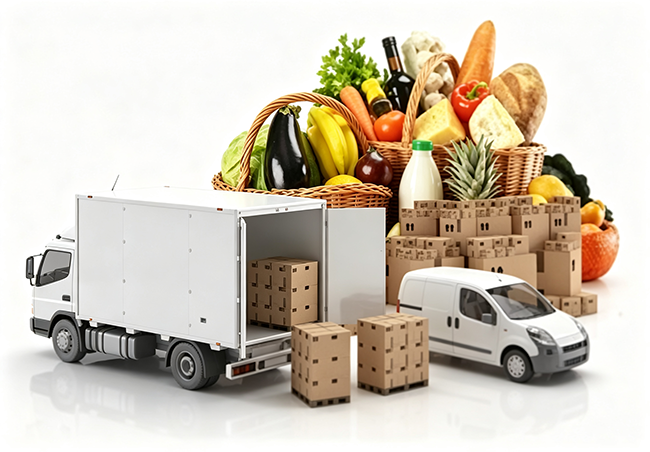
I. Entering the Market: A Food Factory Faces Consumers Directly for the First Time
When a traditional food factory enters Douyin e-commerce, the first challenge is often not technology, but a change in business logic.
In the traditional OEM or distribution model, a factory mainly focuses on production costs, order volumes, and customer payment terms. In e-commerce, however, it must also account for product pricing, platform fees, influencer commissions, paid traffic, packaging, delivery costs, customer service, and after-sales losses.
For example, even if the manufacturing cost of a product priced at only RMB 9.9 is relatively low, once logistics, commissions, and promotional expenses are included, the order may generate little or no profit.
This was why the management team initially had serious concerns about concepts such as “RMB 9.9 with free shipping” and relatively high influencer commissions.
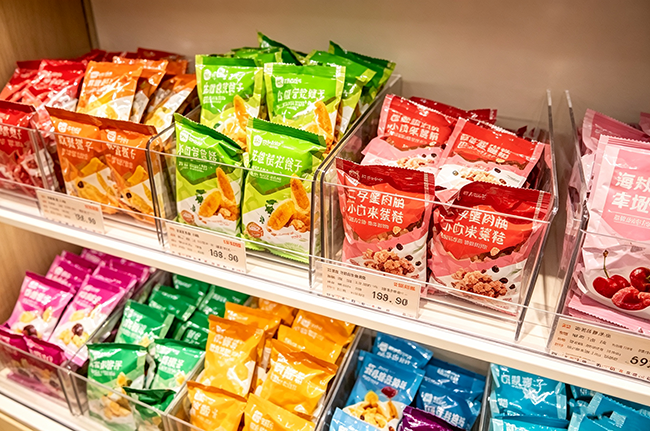
In August 2022, the factory launched its first crispy-pork coating mix aimed directly at consumers.
To acquire its first customers, the team used a relatively low introductory price. However, as a new product with no historical sales or customer reviews, it was difficult to attract leading influencers, while videos produced by smaller creators also struggled to gain substantial organic traffic. The first stage of sales therefore depended largely on the factory’s own livestreaming and paid testing. The team soon discovered that simply increasing influencer commissions would not solve the problem. For many small and medium-sized creators, the most important issue was: How much actual income can one video generate?

The team therefore began providing paid traffic support to selected creator content that showed stronger performance.
However, instead of simply setting a rule such as “increase spending whenever ROI exceeds 1.5,” a more scientific approach is to calculate the break-even point for each product first. Whether a product deserves additional advertising investment depends on product revenue, manufacturing costs, platform fees, influencer commissions, logistics, packaging, after-sales losses, and advertising expenses. Only when an order generates a positive contribution margin—or when expected repeat-purchase value can reasonably cover the initial customer acquisition cost—does scaling advertising make business sense. The team therefore gradually shifted its focus away from simply chasing video views and gross merchandise value and began determining advertising budgets according to product contribution margin and acceptable customer acquisition cost. This shift marked the beginning of more refined e-commerce management.
II. Once Sales Grow, the Real Battle Moves to the Cost Structure
As the number of participating influencers and product impressions increased, orders began to grow rapidly.
The management team soon realized: Growth in sales does not automatically mean growth in profit.
If low-priced SKUs account for too much of total sales, even impressive order volumes can generate low or even negative contribution margins once commissions, logistics, and packaging costs are included.
The factory therefore began breaking down the cost of every order.
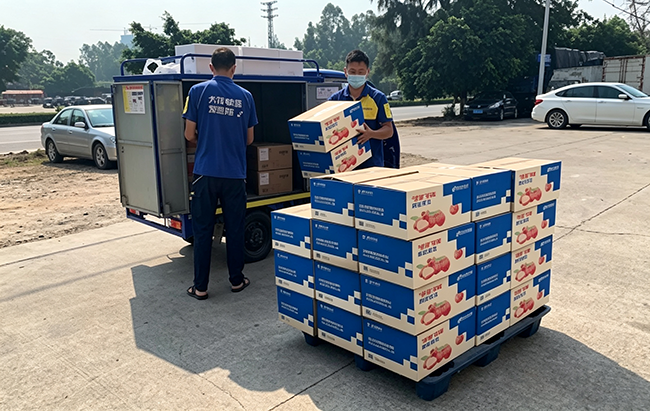
Logistics Optimization
Many parcels weighed approximately 420–450 grams.
If a courier charges the same price for everything below 500 grams, simply reducing a parcel from 450 grams to 420 grams will not directly produce a major reduction in freight costs.
The real value of reducing packaging weight is that it lowers the risk of some parcels exceeding the next billing threshold because of packaging variation, promotional gifts, or other additions.
At the same time, rising order volumes gave the factory greater bargaining power when renegotiating courier rates.
Logistics optimization therefore came from several factors working together, including lighter packaging, improved packaging materials, higher daily shipment volumes, and renegotiated delivery rates.
Following these adjustments, the average logistics cost per order declined.
It is important to emphasize “per-order cost.”
As total sales increase, the company’s overall logistics expenditure will normally increase as well. The more meaningful indicator is whether the average logistics expense required to fulfill each order is falling.
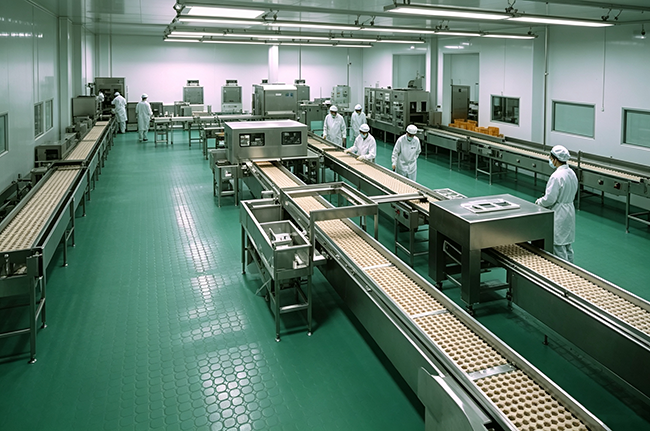
Packing Efficiency
The packing process was also redesigned using a more systematic productivity-management approach.
Workers had previously been paid primarily on a fixed-wage basis. As order volumes increased, the factory gradually introduced a “base salary plus piece-rate incentive” system, while incorporating quality indicators such as incorrect shipments and missing items into performance assessment.
After the adjustment, the number of orders processed per worker per day increased significantly.
Rather than saying that “labor costs fell,” it is more accurate to say that higher productivity reduced the labor cost allocated to each order. This meant that the factory did not have to rely entirely on hiring large numbers of additional workers to support sales growth.
Redesigning the SKU Structure
Another major factor affecting profitability was the product mix.
The team gradually found that consumers who selected the cheapest option were not necessarily unwilling to spend more.
Some simply wanted a low-price reference point before deciding which bundle offered better overall value.
The operations team therefore began emphasizing the differences in value between different package sizes.
A low-priced SKU could serve as an entry-level trial product, while larger bundles could offer better value through increased product quantity, free items, or complementary seasoning products, thereby raising the average order value.
If a product page displays information such as “the percentage of customers choosing this option,” such claims must be based on genuine transaction data rather than fabricated numbers designed to influence consumer behavior.
After the SKU structure was adjusted, the share of higher-value bundles gradually increased.
The team then began combining the crispy-pork coating mix with dipping seasonings and other products linked to the same consumption scenario.
The factory gradually came to understand:
Production determines how low a product’s cost can go, while product design determines whether that cost advantage can ultimately be converted into profit.
III. When Orders Surge, the Fulfillment System Becomes the Real Test
Around the 2022 Double 11 shopping period, order volumes increased further.
This time, the biggest question was no longer whether there was enough traffic. It was:
Could production and warehousing ship the orders on time?
Even with warehouse employees working extended shifts, maintaining delivery efficiency became increasingly difficult.
This exposed a problem many traditional food factories encounter when entering e-commerce.
Traditional production is often organized around large orders from distributors. E-commerce, by contrast, produces large numbers of small, fragmented, high-frequency orders.
The two models require very different production planning and warehouse management systems.
The team therefore began forecasting sales of high-volume SKUs.
For products with relatively stable demand and rapid inventory turnover, the factory prepared a reasonable amount of finished inventory in advance, provided that production dates, batch traceability, shelf-life management, and storage conditions continued to comply with food-safety requirements.
This was not simply a matter of blindly “pre-producing 70% of capacity.”
Instead, historical sales data was used to estimate an appropriate range of safety stock.
The factory also adjusted order cut-off times and negotiated later collection and direct transfer arrangements with courier companies.
Its order-processing model gradually shifted from:
Receiving an order first and then reacting to it
to:
Using sales forecasts to allocate production, inventory, and logistics resources in advance.
This was a critical step in the factory’s transition toward an e-commerce-oriented supply chain.
The After-Sales System Also Had to Change
As order volumes increased, the number of after-sales requests naturally increased as well.
For low-value food products, if every customer complaint requires repeated communication, evidence submission, and manual responsibility assessment, the cost of customer service can quickly exceed the profit generated by the product itself.
The team therefore introduced more efficient review and rapid-refund processes for selected low-value, low-risk after-sales situations.
However, such policies should always be configured according to the latest platform rules, the characteristics of the product, the reason for the complaint, and the level of risk. They should not be understood as an unconditional “refund without evidence for all orders below RMB 15.”
The real objective was not to refund everything automatically, but to:
Resolve low-value disputes at a lower service cost and concentrate human customer-service resources on problems that genuinely require intervention.
As warehousing, logistics, and customer service gradually stabilized, overall store performance improved, providing a stronger foundation for subsequent traffic conversion.
It is also important to recognize that:
Platform traffic should never be simplified into the idea that a higher single score will automatically generate substantially more traffic.
Fulfillment performance, product competitiveness, content quality, conversion rate, and customer reviews all contribute to business performance.
IV. Real Growth Is Not “Out of Control”—It Is Agile at the Front End and Controlled at the Back End
For a food manufacturer, describing growth as “out-of-control growth” is not appropriate.
Food production must remain controlled.
Production batches, raw materials, personnel, equipment, hygiene, testing, inventory, and traceability cannot be allowed to become uncontrolled simply because orders suddenly surge.
A more appropriate growth model for a food factory is:
Respond quickly to the market at the front end while keeping production and quality fully controlled at the back end.
When the sales team identifies a product whose demand is suddenly rising, production planning must respond quickly, but all adjustments must remain within the company’s food-safety system and actual production capacity.
If sales exceed the factory’s safe production capacity, reducing advertising intensity may be preferable to pursuing order volume at the expense of consistent product quality.
This is also a necessary transition for a factory moving from a temporary viral product toward a long-term brand.
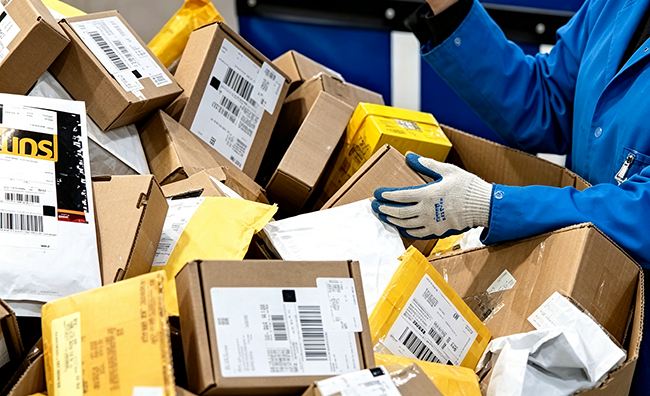
V. From One Best-Seller to Building a Brand
After the 2023 Spring Festival, more similar products began entering the market.
As competition intensified, relying solely on low prices became increasingly difficult as a long-term strategy.
The team therefore began shifting its focus from “selling more crispy-pork coating mix” toward “giving consumers a reason to remember the brand.”
Customer Operations
The factory began providing recipes, cooking instructions, and content services around actual product-use scenarios, gradually building its own membership and customer engagement system.
In practice, companies must comply with the latest platform rules regarding user information, off-platform traffic diversion, and transactions.
The purpose of customer operations should be:
To increase service value and repeat purchases, rather than simply moving consumers from one platform to another to complete transactions.
Multi-Platform Operations
Once the product accumulated more stable sales and customer reviews, the team began expanding to additional e-commerce channels.
Different platforms played different roles.
Douyin was better suited to helping consumers discover products through content, while traditional marketplace platforms could serve users who actively searched for brands or products and support long-term repeat purchases.
The real value of a multi-platform strategy therefore was not simply to “send Douyin traffic to Tmall,” but to make the brand accessible to consumers across different channels.
Supply-Chain Optimization Driven by Sales
Stable sales volumes also changed the factory’s relationship with upstream suppliers.
When purchase volumes were small and orders unstable, the factory had relatively weak bargaining power.
Once sales forecasting became more reliable, the factory could use annual purchasing plans and stable procurement volumes to renegotiate pricing, delivery schedules, and payment terms with suppliers.
The primary benefit of longer supplier payment terms is:
Reduced working-capital pressure and improved cash flow.
The actual amount of financial cost savings, however, must be calculated using procurement value, financing costs, and the real change in payment terms. A fixed savings figure cannot reasonably be claimed without underlying financial data.
Within the scope of its production licenses, food-safety capabilities, and available capacity, the factory could also legally undertake qualified contract-manufacturing projects, allowing idle capacity to be used more efficiently.
The business gradually developed into a dual model of:
Own-brand operations + compliant contract manufacturing.
VI. Behind RMB 6 Million in Monthly Sales, the Real Lesson Is Not a Single Growth Trick
As the Douyin business grew from zero into a more stable operation, the factory looked back and realized that the biggest change had not come from one viral video.
It was not one influencer.
And it was not simply low pricing.
What really changed was the company’s operating logic.
In the past, the factory primarily asked:
How much can we produce?
How much does it cost?
Which distributor will buy it?
Once the company began dealing directly with consumers, it also had to ask:
Why do customers buy the product?
Which SKUs actually generate profit?
How much customer acquisition cost can the product support?
When should products be manufactured?
How much inventory should be prepared?
How can orders be shipped on time?
How should after-sales problems be handled?
And why should consumers buy again?
Traditional manufacturers entering content-driven e-commerce therefore need to build two capabilities simultaneously:
Cost and quality control inside the factory, and consumer insight in the market.
The former determines whether a company can consistently produce compliant, stable, and cost-competitive products.
The latter determines why consumers are willing to buy them.
Only when both capabilities are present can traffic be converted into sustainable business performance.

Conclusion: Douyin Is Not a Lifeline—It Is a Test of Operating Capability
Traditional food factories should not regard short-video platforms and livestreaming simply as new sales channels because they see other companies generating impressive sales numbers.
Traffic only amplifies the capabilities a company already has.
If the supply chain is stable, the product is competitive, the unit economics are viable, and the fulfillment system is mature, traffic can help the company reach consumers faster.
But if the product itself is unprofitable, production capacity is insufficient, the food-safety system is unstable, or after-sales systems cannot support the order volume, greater traffic may simply expose those weaknesses faster.
Therefore, the most important question for a food manufacturer considering content e-commerce is not:
“Can we create a viral product?”
It should be:
“If we suddenly receive 10,000 additional orders tomorrow, can our product economics, production, quality, inventory, logistics, and after-sales systems handle them reliably?”
If the answer is yes, traffic has value.
If the answer is no, the first priority should not be finding more influencers. It should be strengthening the company’s operating foundation.
The food factories that remain competitive in the future will not only know how to manufacture products, but also how to understand consumers. They must not only know how to capture traffic, but also how to control growth.
That is the capability truly worth replicating in the transition from traditional manufacturing to brand-oriented operations.
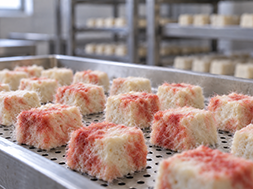
The reddish color of fermented tofu cannot be determined solely by its appearance; sampling and testing are necessary, and the abnormal product must be isolated. Relying solely on disinfectants is insufficient; equipment and the workshop environment must be thoroughly investigated. Air disinfection requires unmanned operation and material isolation. Disinfectants should be used according to specifications, and problems should be identified through a combination of production records and testing.

AB cleaning agents in food factories are prone to producing odor residues; Chlorine dioxide disinfectant can sterilize and deodorize without harmful residues. It can be diluted and used for disinfection of workshop equipment and water bodies, with matching ratios and safety operation requirements.
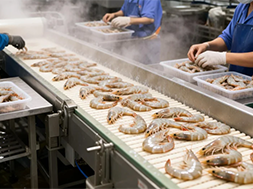
Chlorine dioxide disinfection in food production will produce harmful residues, and the water consumption of traditional large water washing is serious. Four measures can be taken to save water and reduce waste on the basis of ensuring food safety, so as to help enterprises achieve multiple benefits and win-win results.

While switching from sodium hypochlorite to chlorine dioxide disinfection offers advantages such as sterilization, biofilm removal, and fewer disinfection byproducts, the strong oxidizing properties of chlorine dioxide necessitate careful consideration of production line material compatibility: 316L stainless steel should be prioritized for piping, and fluororubber or polytetrafluoroethylene (PTFE) should be used for seals, while also considering the suitability of accessories such as sight glasses and spray nozzles. The switch can be smoothly completed in three steps: establishing material records, conducting a 72-hour immersion test, and carrying out small-scale trial runs and inspections, thus preventing equipment corrosion and damage.
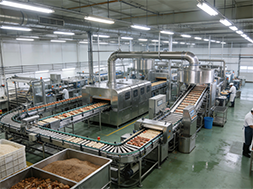
Traditional chlorine dioxide disinfection in food factories is time-consuming and reduces production capacity. Addressing pain points such as solution preparation, spraying, and ventilation monitoring, the process can be optimized in stages through equipment upgrades, zoned disinfection, scientific control of disinfection parameters, and accelerated ventilation monitoring. This phased process optimization, while ensuring safety and compliance, can shorten disinfection time by 30-50%, freeing up production capacity and improving hygiene management.
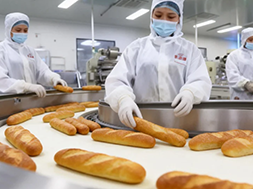
Powdered milk powder and starch dust in the powdered food workshop will absorb and consume chlorine dioxide dry fog, reducing the disinfection effect. It can solve the disinfection problems caused by dust and ensure food safety by reducing dust before disinfection, regulating the particle size of dry fog, pulse releasing agent, optimizing the air flow in the workshop, and matching other disinfection methods.
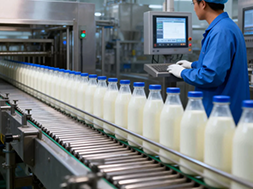
Chlorine dioxide is widely used for disinfection in water supply and food supply chains, but current issues exist regarding standards, procedures, and residue monitoring. It is necessary to standardize operating procedures, establish a comprehensive residue monitoring system, and improve risk warning and emergency response mechanisms to ensure disinfection safety from water treatment plant to table.
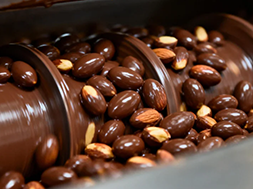
When using chlorine dioxide for disinfection of chocolate equipment, it is necessary to control the residue of the agent to avoid damaging the flavor and quality of the product. The preparation of the agent should be standardized, the disinfection and rinsing process optimized, and residue compliance verified through multiple methods. Since chocolate is a low-moisture food, a customized cleaning plan needs to be developed based on the specific equipment to balance safety and production stability.
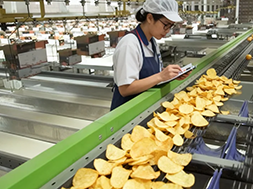
The strong oxidizing properties of chlorine dioxide can cause plastic conveyor belts in food factories to oxidize and age, with different materials exhibiting varying degrees of tolerance. To address this, a more refined approach can be taken, including controlling the concentration, shortening contact time, selecting oxidation-resistant materials, and employing differentiated disinfection methods and rotating disinfectants, thus balancing disinfection effectiveness with equipment protection.
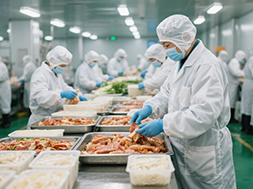
When using chlorine dioxide for disinfection in food production, the disinfectant concentration is a critical control point in the HACCP system. Test strips are convenient to use but have a relatively large margin of error; portable testing instruments offer higher accuracy but require regular calibration and maintenance. Enterprises can adopt a three-tiered monitoring solution: primarily online sensors, supplemented by portable instrument inspection and calibration, and emergency verification using test strips. This enables continuous monitoring, data retention and traceability, ensuring both disinfection effectiveness and food safety.
Northeast of Huangshan Road and Chuangye Intersection, Small and Medium sized Enterprise Entrepreneurship Industrial Park, Shanwang Town, Linqu County, Weifang City, Shandong Province
Copyright © 2025 by Shandong Huashi Pharmaceutical Co., Ltd All Rights Reserved


 Language
 中文
中文 Русский
 Chlorine Dioxide Disinfectant Manufacturer


